
Detail Page Innovation! How to Break Price Resistance and Sell at High Prices (with Creazy)
Why do customers hesitate right before the 'Buy Now' button?
Psychological Barrier: The Brain Perceives Spending as 'Loss'

The biggest reason customers hesitate at the payment stage isn't simply because they 'want to save money.' From a neuroscience perspective, payment is first recognized as the 'pain' of losing one's assets rather than the pleasure of gaining something.
Humans instinctively have a 'loss aversion bias,' reacting much more sensitively to losses than to equivalent gains. The moment a customer checks the price, the brain's pain centers activate, creating psychological resistance.
This is where the concept of 'Mental Accounting' becomes crucial. Consumers evaluate the same amount of money differently depending on the budget category they have set in their minds.
- Cost Perception: A negative emotion that occurs when focusing simply on the act of money leaving.
- Investment Perception: A positive expectation that occurs when focusing on the future value or problem-solving provided by the product.
- Loss Perception: An instinctive rejection felt when the utility gained relative to the expenditure is uncertain.
Ultimately, the seller's core task is to make the customer's brain perceive the payment amount not as 'vanishing money' but as a 'valuable exchange.' Without this psychological shift, even the best products will stay stuck in the shopping cart.
Want to use these perceptions to sell your products?
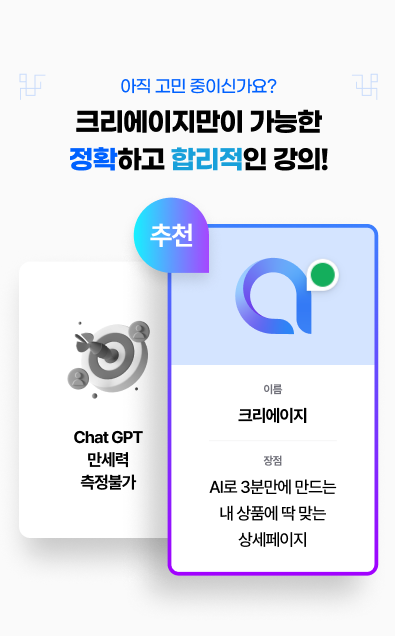
Before presenting the price, sufficiently visualize the benefits the customer will gain. Anticipation must be built up enough to offset the pain for price resistance to decrease.
The Impact of Detail Page Design on Brand Trust
Customers decide a brand's credibility within just 3 seconds of landing on a detail page. Visually unorganized designs lead to the fatal result of undervaluing the product's essential worth.
Messy layouts, unreadable fonts, or low-resolution images send an unconscious signal to customers that 'this company is poorly managed.' This leads to doubts about product quality and acts as a catalyst to maximize price resistance.
Conversely, a well-designed page breaks the cycle of price comparison. Data shows that the top 1% of high-revenue detail pages commonly feature a logical structure considering the customer's eye flow and professional visual elements.
Mid-term Summary
- Law of First Impressions: Provide overwhelming trust with high-resolution images and clean headlines.
- Visual Hierarchy: Reduce customer fatigue by clearly distinguishing between important and supplementary information.
- Consistent Tone & Manner: Prove that it is a 'trustworthy place' through colors and design elements that reflect the brand identity.
Ultimately, detail page design is not just a decoration; it is one of the most powerful marketing tools to resolve customer anxiety and open their wallets.
3 Psychological Pricing Strategies to Persuade the Customer's Brain
1. The Power of the Last Digit: Charm Pricing Strategy
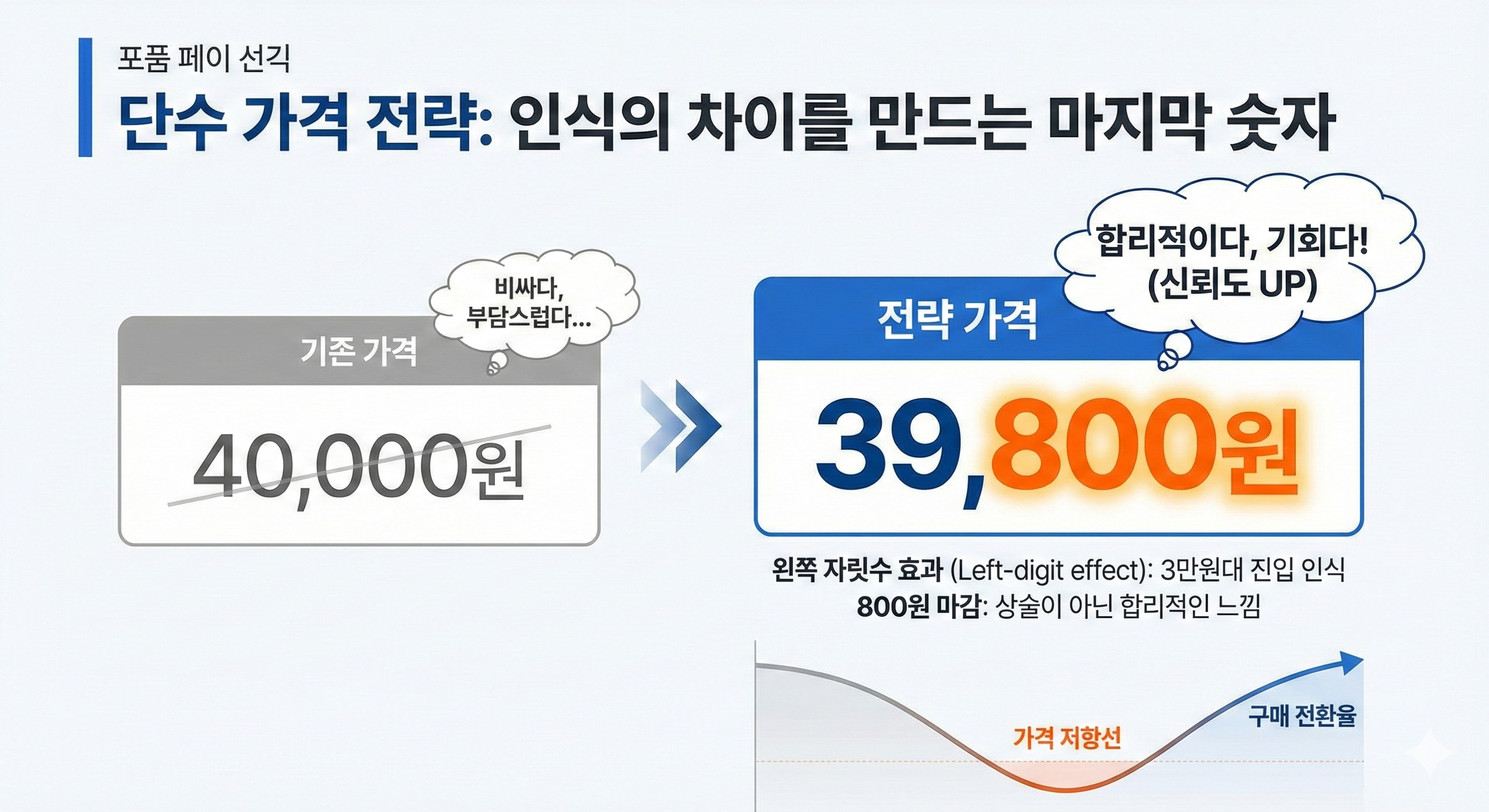
The consumer's brain reads numbers from left to right. The difference between $40.00 and $39.80 is only 20 cents, but the moment the first digit changes from 4 to 3, the customer perceives they have entered a completely different price bracket. In psychology, this is called the 'Left-digit effect,' and it is particularly powerful for low-involvement products where purchase decisions are made quickly.
In the past, ending prices with .99 was common, but recent trends have become more sophisticated. As the perception grows that .99 feels too much like a sales tactic, ending prices with .80 or .70 is gaining more trust. Research shows that prices ending in 8 often make a product look more reasonable and sophisticated than those ending in 9.
Tip: Actively use charm pricing for consumables or daily necessities that emphasize cost-effectiveness, but for premium products where brand value is important, it's better to keep the numbers clean and rounded.
2. Shaking the Standard of Comparison: Anchoring Effect
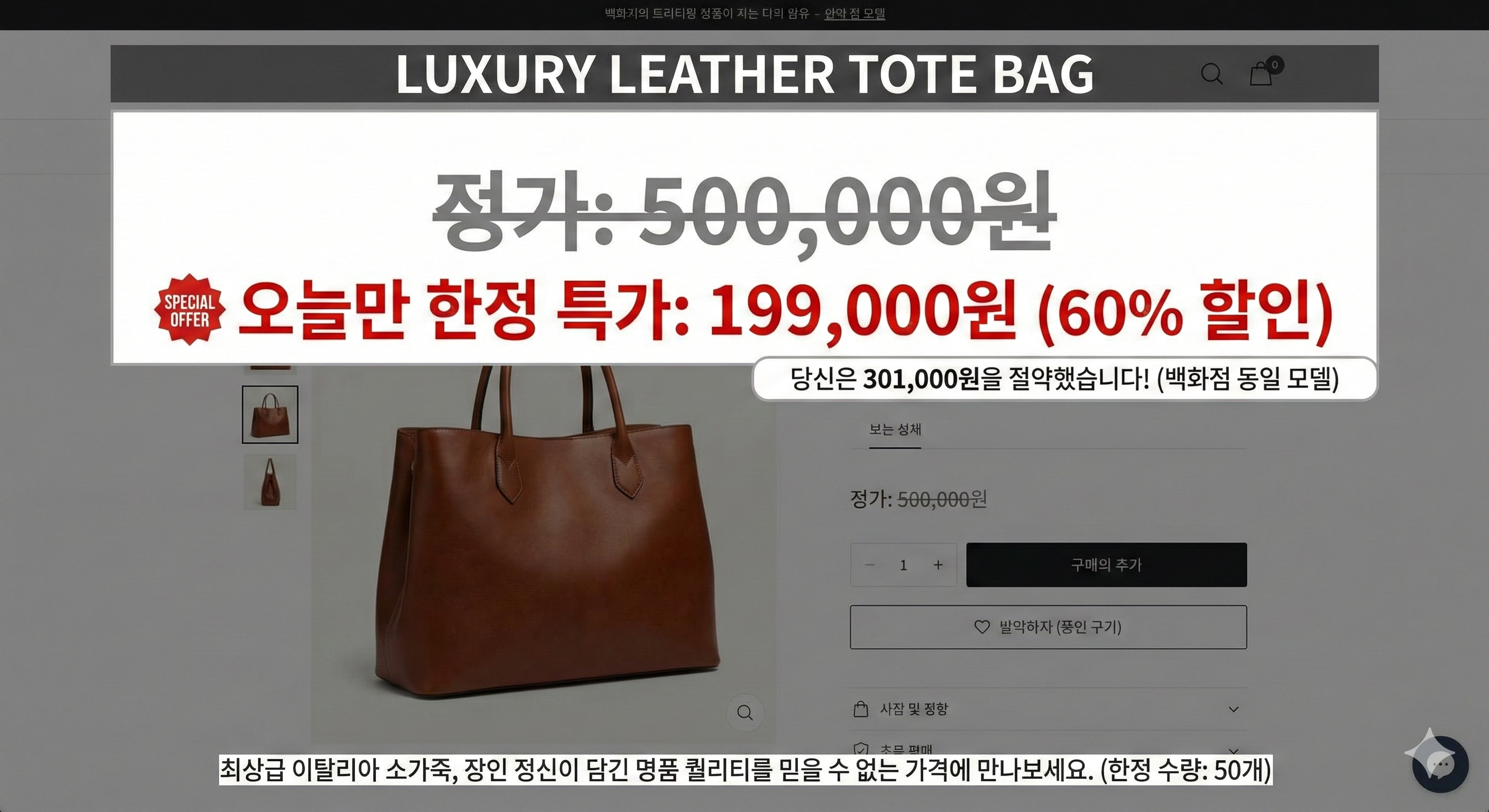
The human brain tends to make decisions through relative comparisons rather than judging absolute value. Just as a ship cannot move once it drops its anchor, the first piece of information presented gets stuck in the brain and becomes the standard for subsequent judgments—this is the 'Anchoring Effect.'
The most representative use case is displaying the 'Original Price.' Rather than just showing "$29.90," showing "$50.00 → $29.90" makes the customer's brain use $50.00 as the benchmark for value. In this process, the customer feels a reward psychology of 'saving $20.10' and focuses on the 'discount range' rather than the product's intrinsic value.
Also, placing a high-end premium line at the top of a menu is a strategy. A $70 bottle of wine feels like a relatively cheap and reasonable choice to a customer who saw a $200 bottle first.
Tip: Adjust the visual distance between the anchor price (standard) and the selling price. When emphasizing the discount rate, increase the font size and use contrasting colors to maximize the anchoring effect.
3. The Architect of Choice: Decoy Effect
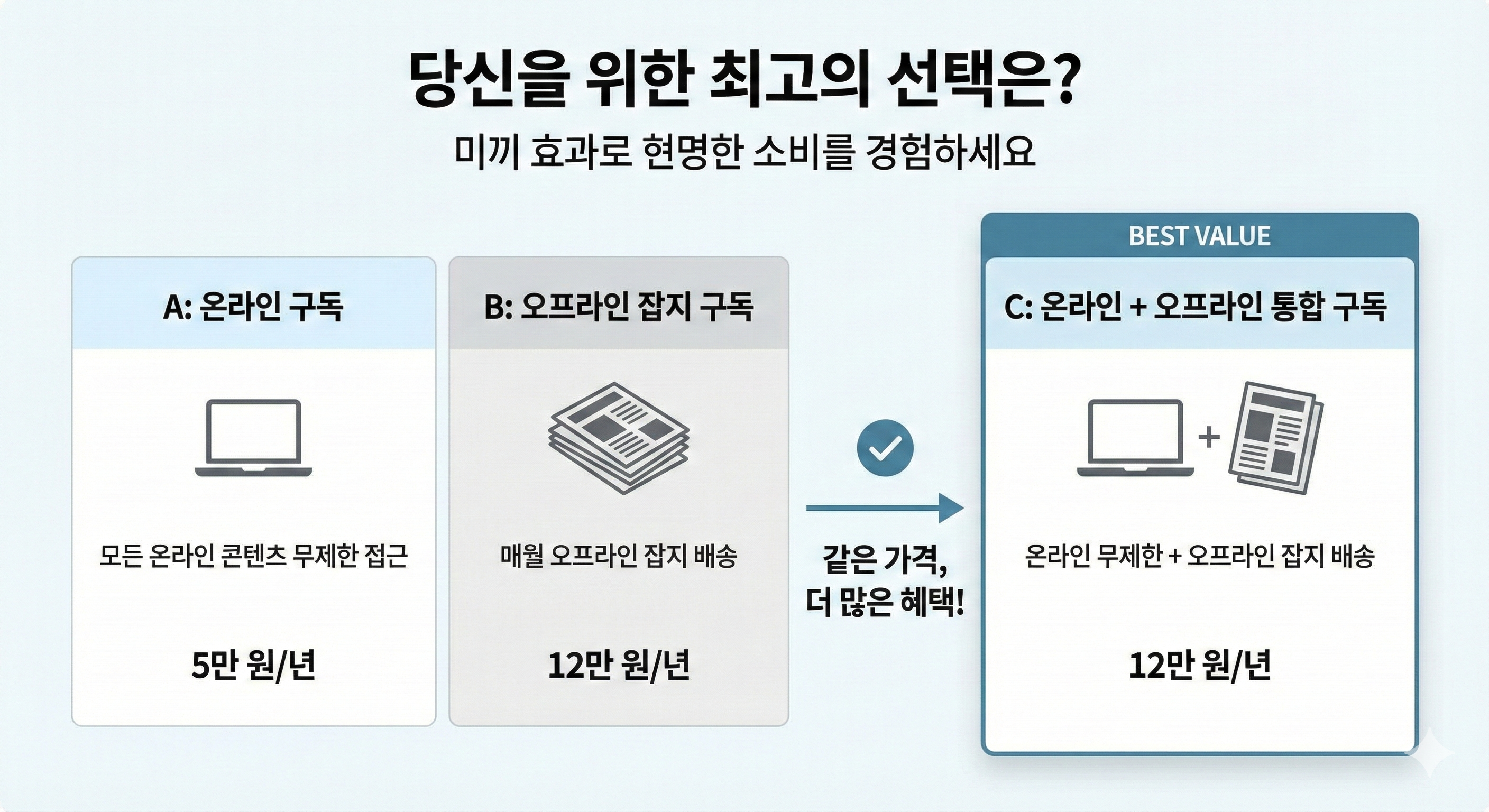
If a customer is struggling to decide between two options (A and B), you can dramatically increase the attractiveness of a specific product by introducing a third option: the decoy. This is also known as the 'Asymmetric Dominance Effect.'
A famous example is the magazine subscription model.
A: Online subscription ($50)
B: Print subscription ($120)
In this case, many customers choose the cheaper A. However, adding a decoy option changes the result entirely.
A: Online subscription ($50)
B: Print subscription ($120)
C: Online + Print subscription ($120)
Here, 'B' (which costs the same as C but offers fewer benefits) acts as the decoy. Customers conclude that "C is a much better deal than B," leading them to choose the most expensive option, C. The core of the decoy effect is making the customer feel a sense of control, believing they made a 'rational choice' on their own.
Tip: Intentionally place a 'supporting product' that is less cost-effective than your main Push Item. Customer hesitation time decreases while the average order value increases.
By using these laws, you will be able to increase your conversion rate and boost sales. But does it feel like there are too many laws to handle one by one? If so, try Creazy, an AI detail page program that applies all these principles automatically!
How Creazy, the Detail Page AI, Maximizes Conversion Rates?
AI Planning Powered by 10,000+ Success Data Points
The most common mistake sellers make when creating detail pages is thinking that 'pretty design' equals 'selling design.' However, true conversion happens not from visual flashiness, but from a logical narrative structure that penetrates the customer's psychology.
Creazy is not just a tool for generating good-looking images. It has learned from over 10,000 top 1% detail pages proven by actual sales data to suggest a content structure that compels consumers to click the buy button.
High-Quality Design Completed in Just 3 Minutes
The traditional way of creating detail pages required endless communication and revisions with planners and designers. This consumption of time and cost often becomes a major barrier for small brands or solo sellers.
With Creazy's AI solution, all preparation is finished just by entering the core product information. The AI agent analyzes the input and produces professional-level results in just 3 minutes—a figure that increases efficiency by more than 100 times compared to traditional outsourcing.
The overall production process is simple:
- Input Product Info: Briefly enter the product's features, target audience, and key selling points.
- AI Planning & Analysis: Based on learned data, it generates a layout and copywriting optimized for that category.
- Design Auto-completion: Instantly check the final detail page with high-resolution images and text arranged according to the plan.
- Easy Editing: Finish the page by having the AI modify parts you don't like or editing them directly.
Mobile-First Layout and Trigger Point Design
Currently, over 80% of online shopping occurs in a mobile environment. Therefore, designs tailored only for PC screens hinder readability for mobile users and eventually cause high bounce rates.
Creazy designs layouts based on a Mobile-First strategy. It places appropriate margins so that text doesn't clump on narrow screens and accurately pinpoints where the customer's eyes should rest as they scroll down.
In particular, the placement of 'Trigger Points' that lead to purchase decisions is Creazy's core technology. The AI strategically places elements to break down the customer's psychological resistance:
- Presentation of Social Proof: Optimal positioning of reviews and certification marks to increase trust.
- Emphasis on Scarcity and Urgency: Visual devices to highlight limited quantities or time-limited offers.
- High-Readability Fonts and Contrast: Text sizes and color combinations that stand out at a glance on mobile.
⬇️ Click the image to connect to the Creazy service.
Frequently Asked Questions (FAQ)
Detail page production is a key factor in the success of an online business. However, many sellers worry about design costs, time, and the difficulty of planning. Here are clear answers to the most frequently asked questions about how Creazy's AI technology solves these problems.
Q1. Is the design quality of AI-made pages as high as professional outsourcing?
To conclude, Creazy provides results that combine a professional's sense with the science of data. It doesn't stop at just looking good; it designs layouts optimized for conversion by learning from 10,000+ top 1% success data points.
While outsourcing to a professional designer takes days or weeks, the AI completes high-quality designs that fit your brand's mood in just 3 minutes. From mobile readability to trigger points that capture attention, the AI calculates and places everything precisely, so you can expect business results that exceed those of manual outsourcing.
Q2. Can it plan for specific product categories?
Yes, it can. Creazy possesses category-specific logic that penetrates the different purchase psychologies of consumers across various industries. From clothing and food to electronics, beauty, and even educational services, we apply an optimized planning framework for each field.
Q3. Can I directly edit the created detail page later?
The result created by the AI is not necessarily the final version. We provide powerful editing features so that the user's intent can be 100% reflected. Using the built-in AI editor, you can modify text, replace images, and change section orders with a few clicks without any coding or complex design knowledge.
For professionals who want even more precision, we support the 'Export Figma Source File' function. Designers can add fine touches based on the solid plan and draft provided by the AI, increasing work efficiency by more than 10 times. Since the freedom of modification is guaranteed, you can fill in the brand's unique identity to the very last detail.
"Everything from planning to design and revision takes place within one workflow. You no longer have to wait for a designer's response to request a revision."
Q4. Is it easy for beginner sellers to use?
Creazy aims to be a 'tool anyone can start using in 1 minute.' You don't need to learn heavy tools like Photoshop or Illustrator at all. Just enter the product name and a few key features, and the AI agent will perform all the complex processes from writing the plan to placing the images for you.
⬇️ Click the image to start using Creazy right away!
Related Posts
AI Detail Page Builders vs. General-Purpose AI Like ChatGPT — What's the Difference?
[Update & Pricing Plan Renewal Pre-Announcement] Now Even Animated Detail Pages?! April 30 New Features & Pricing Plan Renewal Notice
Hello, this is the Creazy team, your reliable partner for CEOs! 🎉 To help our CEOs create high-quality…
The Standard for Detail Page Color Combinations (with Creazy)
Detail Page Creation: Why Does a Single Color Change Sales? The detail page is the most powerful touchpoint…