
How to Make a Cosmetics Product Detail Page: Build It in 6 Steps Without Banned Claims
A cosmetics product detail page in 6 steps, from the first screen to Korea's required product information, with what to put in each. Plus claims Korean law bans, rewritten examples, and a sample body lotion page we built and fixed.

Summary
- Build a cosmetics product detail page in this order: first screen, the customer's problem, texture, ingredients, how to use, purchase information. It makes it harder to leave something out.
- Under Korean rules, you can't use claims that make a cosmetic look like a medicine, claims that make a product look like a registered functional cosmetic when it isn't one, or numbers you can't back up.
- With Creazy, you start from one photo and one line of description, fix the draft by chat, and export it at the Naver Smart Store width (860px). Ingredients, numbers, and required label values still come from your actual product.
"The photos look good, but I don't know what to put first on the detail page."
"Can I use words like 'skin regeneration' or 'soothing'?"
The first is answered by the section order, the second by the wording rules. Below are the 6-step section order, rewritten claim examples, and a body lotion detail page we made with Creazy, in that order.
1. Why the structure comes first on a cosmetics detail page
A detail page is read from top to bottom, so the order of your sections is the order in which you answer the customer's questions.
A cosmetics detail page needs to answer three main questions.
- Will it suit my skin?
- How does it feel on the skin?
- Can I trust it?
Put the sections in the order that answers these questions, and the page reads well before the design even comes in.
2. The section order at a glance
| Step | Section | The customer's question | What to include |
|---|---|---|---|
| 1 | First screen | Is this product for me? | Product photo, one line on when to use it, volume |
| 2 | The problem | Is this about me? | When and in what moment it's uncomfortable |
| 3 | Texture | How does it feel? | Close-up of the texture, a description of how it feels |
| 4 | Ingredients | What's in it? | Ingredients actually in the formula and why they're there |
| 5 | How to use | How do I use it? | Order, amount, and when to apply |
| 6 | Purchase information | Can I trust this purchase? | Required product information, shipping and exchange |
There's no fixed number of sections. Add or merge them to fit your product. When you're done, just check that none of the six questions above is left unanswered.
3. How to fill each section
① First screen: say who it's for
Include Product photo · one line on when to use it · volume
Avoid A moisturizing body lotion
Try A body lotion for when your skin feels tight after a shower
Tip Saying when to use it shows who the product is for better than a single adjective does.
② The problem: a situation, not a symptom
Include One scene where the customer feels the discomfort
Avoid We treat dry skin
Try Right after a shower, when your skin feels tight
Watch out Disease names or "it cures" make the product read like a medicine.
③ Texture: photos over words
Include A dab on the back of a hand · a hand spreading it · a close-up of the texture
Tip Show the texture with photos instead of a long description.
Watch out If you use AI-made styled images, compare them with the real product's texture and color.
④ Ingredients: say why, don't just list
Include Ingredients actually in the formula · the feel you added each one for
Avoid Contains ingredient A, ingredient B, ingredient C
Try We added ceramide so your skin feels less tight after a shower
Watch out Don't write an ingredient's properties as if they were the product's effects. Only include numbers when you have data to prove them.
⑤ How to use: order, amount, timing
Include When · how much · in what order
Tip Match the wording to the directions on the product label.
⑥ Purchase information: required product information and shipping
Include The 11 cosmetics items in Korea's required product information notice, plus shipping and exchange information
- Source: Korea Fair Trade Commission, Notice on Providing Information on Goods in Electronic Commerce (in Korean)
- For example: volume, expiry date, manufacturer, full ingredient list, precautions, customer service phone number
Watch out Fill in every value from your actual product records.
Checklists for other categories are in Must-Haves for Your Product Detail Page (Category-Specific Checklist), and how to split the planning work with AI is in 4 AI Product Detail Page Prompts + a Structure That Sells.
4. Claims you can't use, and how to rewrite them
An online detail page counts as advertising too. In Korea, the rules are Article 13 of the Cosmetics Act and Annex 5 of its Enforcement Rules.
| Type | Claims you can't use | Try this instead |
|---|---|---|
| Looks like a medicine | Skin regeneration, cell regeneration, improves atopic dermatitis | A moisturizing feel that leaves skin less tight after a shower |
| Looks like a functional cosmetic | Whitening, wrinkle improvement (for products not reviewed or reported as functional cosmetics) | Smooths the look of skin texture for a clearer look |
| Expert endorsement | Developed by Dr. OO, hospital-only cosmetics | Real usage scenes and a description of how it feels |
| Absolute claims | The best, top-class | A lotion texture that's easy to apply right after a shower |
| Unfounded content | Unproven numbers, certifications or labs that don't exist | Only what you have proof for |
| Putting others down | Other lotions feel sticky | Describe only how your own product feels |
- Swapping words isn't enough. If the sentence as a whole still promises an effect, the problem stays, so check the whole sentence.
- Get the data first for numbers and test results. The seller has to be able to prove factual claims in labels and ads (Cosmetics Act, Article 14).
What changes on November 27, 2026
Ads that use AI-made virtual sound, images, or video that are hard to tell from reality, to make it look as if a doctor, pharmacist, or other expert recommends the product, are added to the list of bans in Article 13 of the Cosmetics Act.
So don't use AI-made images or video with scenes that look like a doctor, pharmacist, or other expert recommending the product.
Sources (Korea National Law Information Center, in Korean): Cosmetics Act, Cosmetics Act amendment history, Enforcement Rules of the Cosmetics Act (Annex 5)
5. We made one with Creazy
We made a cosmetics detail page for a fictional ceramide body lotion that isn't for sale.
STEP 1. Pick a category
In the detail page categories, pick Beauty/Cosmetics.
STEP 2. One photo + one line
- Photo A "Ceramide Body Lotion 400ml" bottle on a blue background
- Description A lotion with ceramide, for people whose skin feels tight after a shower
- Leave out Sales figures, "No. 1," review counts, clinical or percentage figures, before-and-after comparisons, doctor recommendations
- Mood Clear blue and white, water on bathroom tiles after a shower, a soft lotion texture
STEP 3. The result
13 styled images were made first, then 15 sections filled in from the top. We described the mood in one sentence, and it came through well.
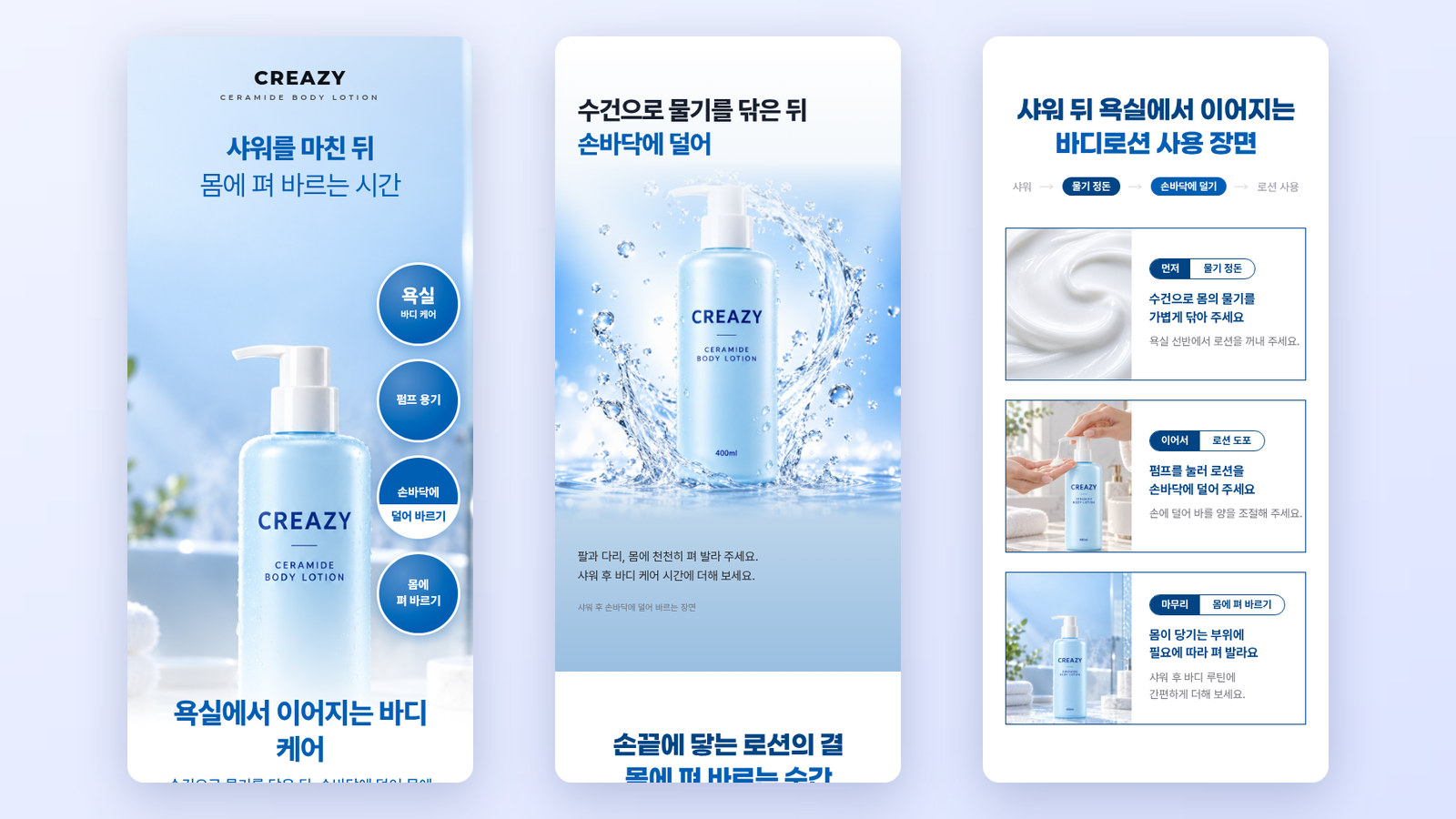
A detail page that started from one photo and one line, then was fixed by chat. (Fictional product)
What we fixed by chat
- Ingredients we never gave had been added, so we took them out and kept only ceramide.
- Photos that looked like before-and-after comparisons and lab backgrounds were changed to text cards and bathroom scenes.
- Required information (expiry date, manufacturer, phone number) had placeholder values, so we replaced them with "seller to fill in."
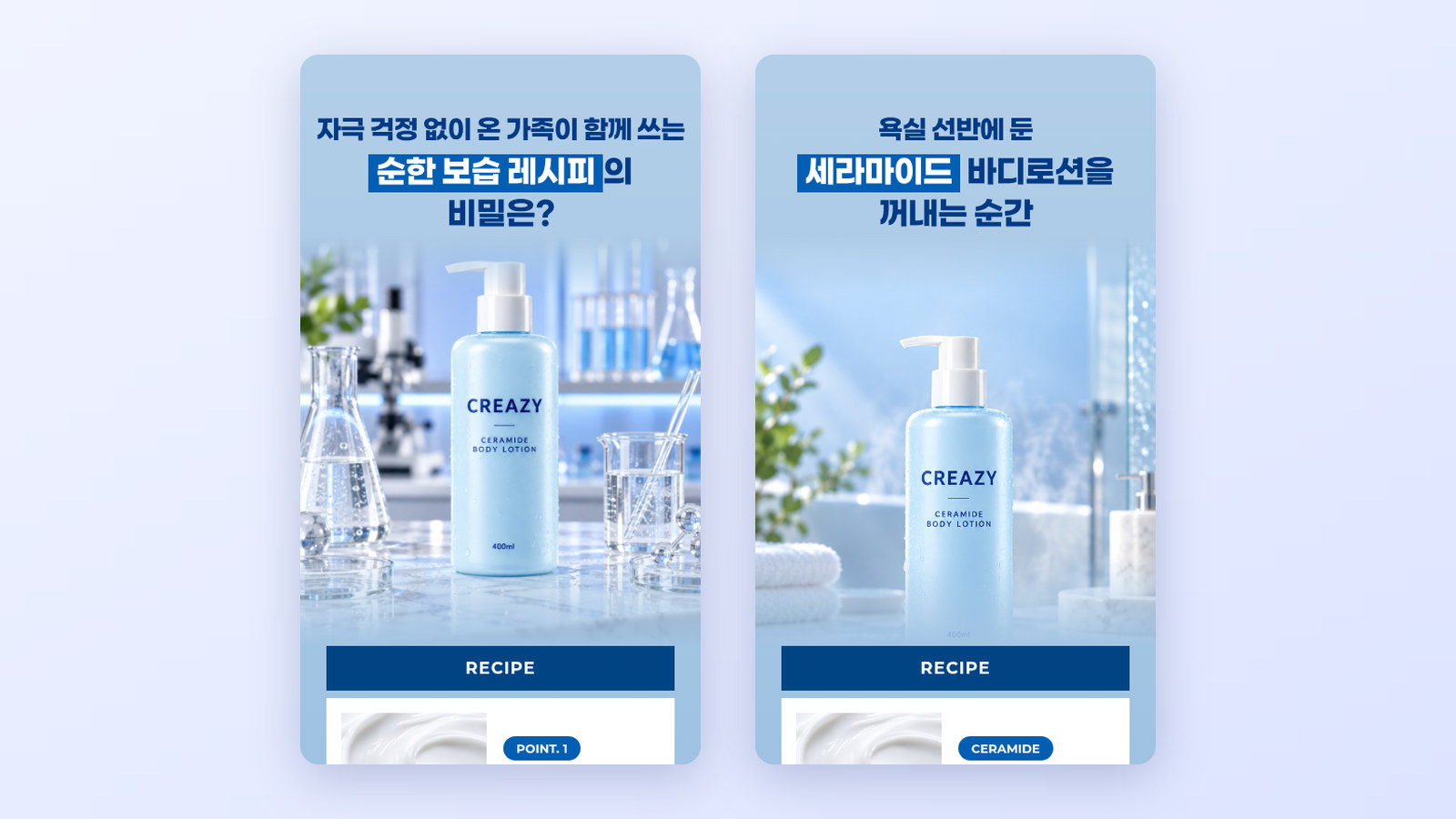
Left is the first version, right is after fixing it by chat. (Fictional product)
What we learned If you put in the real ingredient list, a description of the texture, and how it actually feels from the start, there are fewer blanks for the AI to fill in on its own, and the copy has more real material to work with. You can see how chat editing works in the Creazy guide.
You can export the finished page as images, to Figma, to Photoshop, or as a web page, and save the images at the Naver Smart Store width (860px).
Wrapping up
- A cosmetics detail page starts with putting the sections in the order customers want answers.
- Describe when to use the product and how it feels, without promising effects.
- Make the draft quickly, then fill in ingredients, numbers, and required values from real records.
Sign up and you can make 2 detail pages for free.
FAQ
Can I use words like "moisturizing" or "soothing" on a cosmetics detail page?
It depends on the product and the sentence. First check that it doesn't read like a medicine and that you can prove it. What matters is how the whole sentence reads, not one word.
When can I use whitening or wrinkle-improvement claims?
Only for products reviewed by, or reported to, Korea's Ministry of Food and Drug Safety as functional cosmetics, and only within that scope.
Do I have to list the full ingredients on the detail page?
Yes. The full ingredient list is one of the cosmetics items in Korea's required product information notice. Replace any ingredient list the AI wrote with the one on your actual product label.
Can I include testimonials or reviews?
Only use real reviews. Even a real review has to be edited if it reads like a medicine or claims effects beyond what a functional cosmetics review or report covers.
Can I use the copy Creazy writes as is?
Check the facts and the wording before you publish. Creazy is a tool for making drafts, so it can add things you didn't put in.
How many photos do I need?
You can start with one. If you have real texture photos or a photo of the back of the package, add them too.